Cut Regression Cycles from
Days to Hours.

Selenium, Playwright, Cypress, Appium. Framework selection, suite design, CI/CD integration, and ongoing maintenance. 60–80% automation coverage in 90 days

60% regression cycles with reusable automation suites
1M+ test cases executed across Selenium, Cypress, Playwright & Appium
50+ enterprise clients across web, mobile, and API automation
Frameworks we work in
Selenium Playwright Cypress Appium Robot Framework
CI/CD integrations
Jenkins GitLab CI Azure DevOps

Free Automation ROI Calculator

Get Your Automation ROI Calculator + Free Framework Assessment

Tell us your stack — we'll recommend the right framework and estimate your regression cycle savings within 24 hours.

ISO 27001 Certified 150+ Global Clients 14+ Years Delivery

Interested in joining our Team? Email us at [email protected]

Vervali Systems
Delivering Speed, Accuracy & Reliability with Automation

60%

Less testing effort with reusable scripts

14+

Years of

QA Excellence

99.9%

Accuracy
in Automation

Not sure which framework fits your stack?
React, Angular, Vue, Next.js web app Playwright or Cypress
Legacy web app (Java / .NET) Selenium + TestNG
iOS + Android mobile app Appium
API + microservices REST Assured + Newman
Mixed web + mobile + API Selenium + Appium + Newman

Quality, Speed, and Accuracy Powered by Automation.

Functional & Regression Test Automation

Automate repetitive functional and regression tests to ensure stability and accuracy in every release while reducing manual effort.

Mobile Test Automation

Deliver flawless mobile experiences by automating iOS and Android app testing across real devices, OS versions, and networks.

Cross-Browser & Cross-Platform Automation

Guarantee consistent performance by automating tests across multiple browsers, devices, and operating systems.

API Test Automation

Validate APIs for functionality, performance, and security through automated testing of integrations, responses, and workflows.

CI/CD Integrated Automation

Embed automation into DevOps pipelines to enable continuous testing, faster feedback, and quicker release cycles.

AI-Powered Test Automation

Automate testing with AI-driven scripts, predictive coverage, and self-healing capabilities to reduce effort, boost accuracy, and accelerate releases.

Automation Testing Services

Accelerate releases with AI-powered automation frameworks. Our automation testing reduces manual effort, speeds up regression cycles, and ensures 24/7 test execution.

Frameworks:

60% faster regression cycles

99.9% accuracy with self-healing locators

Supports CI/CD pipelines

GitLab

AI-Powered Test Automation

Accelerate releases with AI-powered automation frameworks. Our automation testing reduces manual effort, speeds up regression cycles, and ensures 24/7 test execution.


Predictive Test Coverage

Focus on high-risk areas

Self-Healing Locators

No broken scripts on UI changes

Intelligent Reports & Dashboards

Real-time defect analytics

Continuous
Testing

CI/CD pipeline integration

Why Vervali?

Delivering smarter, faster, and scalable digital solutions powered by intelligent automation and expert talent.

AI- Powered QA
AI- Powered QA

Smarter testing, fewer bugs. Our proprietary AI-driven frameworks analyze codebases to uncover hidden issues and optimize test coverage beyond human capabilities.

Scalable Collaboration

From MVPs to enterprise rollouts, our flexible engagement models scale with your needs—ensuring you get the right support at every stage.

Trusted & Certified Experts

Work with certified professionals (ISO 27001, ISTQB) who bring precision, compliance, and a quality-first mindset to every software delivery.

Book a Free Consultation

TECHNOLOGY EXPERTISE

Powering Innovation with the Right Tech Stack

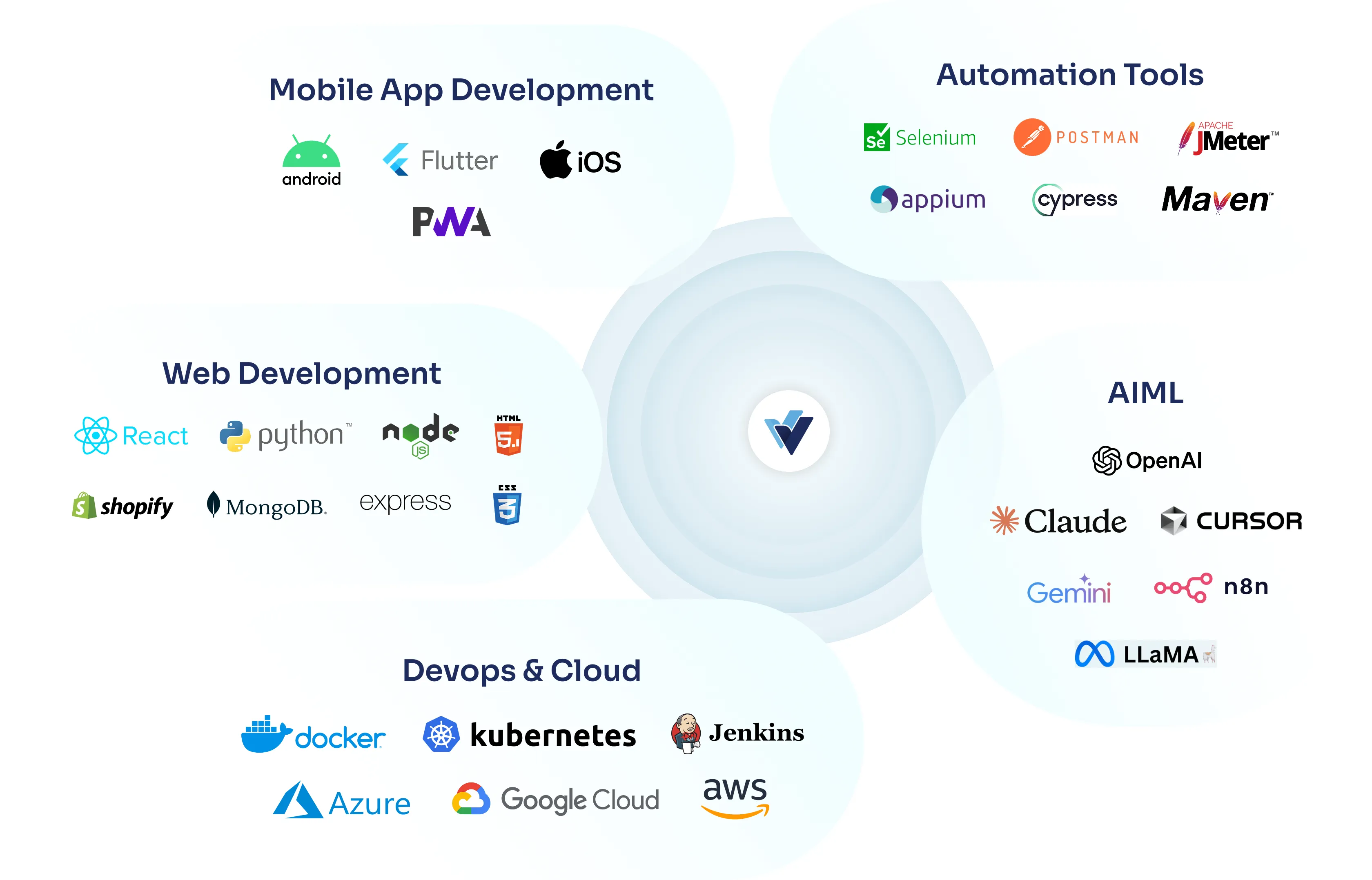
At Vervali, we leverage the most trusted and modern tools across web, mobile, automation, cloud, and AI to build robust, scalable, and intelligent digital solutions. From HTML, React, and Flutter to OpenAI, Docker, and AWS—our tech ecosystem ensures faster development, seamless integrations, and accelerated time-to-market.

Technology Expertise
Dedicated Teams
Dedicated Teams Icon

Hire Vervali as your extended dedicated team and scale it as per the project requirements.

Managed Delivery
Managed Delivery Icon

Outsource your complete project to Vervali where we take care of end-to-end execution with dedicated resources.

Per Project Pricing
Per Project Pricing Icon

Pay for the resources you use for fixed projects with defined timelines and deliverables.

Resource Augmentation
Resource Augmentation Icon

Hire talent from our resource pool that exactly meets your project requirements.

TESTIMONIALS

What do clients say about us?

Awards and Recognitions

Delivering Quality Through Testing
and Building Apps
That Perform

enterprise
award
clutch
upwork
istqb
award
award
growing-companies
software-company
Top Custom Software Development Companies in USA
Top Web Development Agency in India
B2B Expert

Frequently Asked Questions

An SDET (Software Development Engineer in Test) and a QA engineer are related but not the same role. QA engineers focus on finding defects through manual or automated testing. SDETs write and maintain the test automation frameworks and tools themselves, requiring stronger software development skills. In practice, the roles overlap, and some organizations use the titles interchangeably, but SDETs typically carry more coding responsibility than traditional QA engineers.

Five widely used automation testing tools are Selenium (web UI testing), Playwright (cross-browser testing), Appium (mobile testing), JUnit and TestNG (Java-based unit and integration testing), and Cypress (JavaScript-focused end-to-end testing). The right choice depends on your technology stack, the types of tests you need, and your team's language expertise. Many projects combine more than one tool to cover different testing layers.

The seven stages of software testing are: requirements analysis, test planning, test case design, test environment setup, test execution, defect reporting and tracking, and test closure. These stages apply to both manual and automated testing. Automation testing services typically focus on stages three through five, building and running scripts that can be reused across releases, while reporting and closure activities feed directly into release decisions.

AI is not replacing Selenium; it is being built on top of it. Features like self-healing locators use AI to automatically update test scripts when UI elements change, reducing maintenance overhead. Selenium remains the underlying browser automation standard for many enterprise projects. AI capabilities are being added to automation frameworks to make tests more reliable and easier to maintain, not to replace the frameworks themselves.

Automation testing is the practice of using software tools and scripts to execute test cases, compare actual results to expected results, and report outcomes without manual intervention. It is used to run repetitive tests such as regression suites quickly and consistently across builds. Automation testing services provide the expertise, tooling, and frameworks organizations need to build and maintain these automated test suites as part of their software delivery process.

Automation testing services are most valuable when your team releases software frequently, runs the same regression tests repeatedly, or lacks in-house expertise to build and maintain test frameworks. They are also useful when scaling test coverage across multiple browsers, devices, or environments. Conversely, exploratory testing, usability testing, and tests for features that change often are typically better handled manually rather than automated.

Tests well suited for automation include regression tests, smoke tests, load and performance tests, data-driven tests, and repetitive functional tests with stable requirements. Unit tests and API tests also benefit strongly from automation due to their fast feedback cycles. Tests that involve subjective judgment, frequently changing UI elements, or one-time scenarios are generally poor candidates, as the cost of building and maintaining scripts outweighs the time saved.

Achieving 100% test automation is not practical for most software projects. Some test types, such as exploratory testing, usability reviews, and accessibility assessments, require human judgment that scripts cannot replicate. Maintaining full automation also becomes costly as UIs and features change. A realistic goal is automating the stable, high-frequency tests that deliver the most consistent value, while keeping a focused set of manual tests for areas where human observation is necessary.
Book Free Consultation WhatsApp