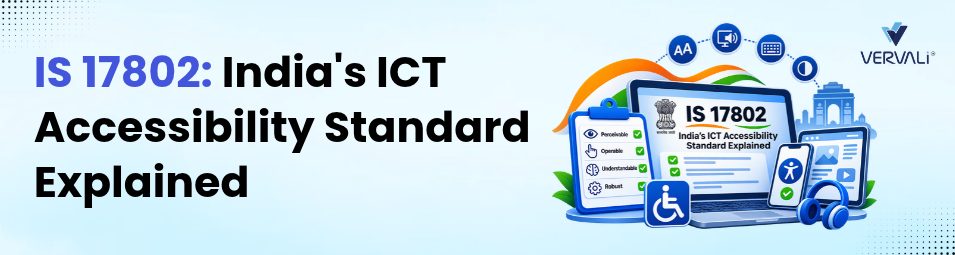


IS 17802 is the Indian Standard for accessibility of information and communication technology (ICT) products and services, published by the Bureau of Indian Standards in two parts: Part 1, Requirements (2021), and Part 2, Determination of Conformance (2022). Part 1 is a technical adoption of the European standard EN 301 549 v3.2.1, and Part 2 sets out how to test against Part 1. Web content conforms by meeting WCAG 2.1 Level AA. The Rights of Persons with Disabilities (Amendment) Rules, 2023, in force since 11 May 2023, say websites, apps and other ICT products and services shall comply with both parts. In November 2024 the Supreme Court held Rule 15(1) "ultra vires the scheme and legislative intent of the RPWD Act", directed the government to delineate mandatory rules and said compliance with the existing standards must continue, and SEBI names IS 17802 for every regulated entity.
Part of Vervali's accessibility cluster: this is the IS 17802 spoke under the WCAG 3.0 accessibility compliance guide hub, alongside the India banking spoke on accessibility standards and guidelines for the banking sector and the accessibility testing services guide.
What You'll Learn
- What Part 1 and Part 2 of IS 17802 contain
- How IS 17802 maps to EN 301 549 and WCAG 2.1 Level AA
- Who must comply in India, and how Part 2 says to test
| Fact | Detail | Source |
|---|---|---|
| Part 1 | IS 17802 (Part 1):2021, Requirements, established 24 December 2021 | BIS |
| Part 2 | IS 17802 (Part 2):2022, Determination of Conformance, established 29 April 2022 | BIS |
| Web bar | WCAG 2.1 Level AA (Part 2, clause 5.1.2) | BIS |
| Legal basis | Rule 15(1)(c)(iii), RPwD Rules, 2017, since 11 May 2023 | G.S.R. 359(E) |
What is IS 17802?
BIS publishes the two parts separately, each with its own year: IS 17802 (Part 1):2021, Requirements, established on 24 December 2021, and IS 17802 (Part 2):2022, Determination of Conformance, established on 29 April 2022. BIS lists two amendments to Part 1. Quotes on this page are from the published 2021 and 2022 text.
Both forewords call it "the technical adoption of the European Standard EN 301 549 v 3.2.1", developed by CEN, CENELEC and ETSI. Per the Part 2 foreword, India's changes are "limited to referencing the relevant regulatory context (Rights of Persons with Disabilities Act, 2016) and the official languages of India", and "The technical coverage is otherwise identical."
What do IS 17802 Part 1 and Part 2 cover?
Part 1 states the requirements and Part 2 says how to prove them. Part 1's scope clause hands over the testing: "The conformance criteria on test descriptions and evaluation methodology are covered in Part 2 of this standard." Part 2 "specifies the test procedures and evaluation methodology" and "also gives guidance in preparing the accessibility conformance report for ICT products and services against each requirement". It is to be read in conjunction with Part 1, so plan to get both.
Part 2 holds one test table for each group of Part 1 requirements, Table 1(a) to 1(i): generic requirements, ICT with two-way voice communication, ICT with video capabilities, hardware, web, non-web documents, software, documentation and support services, and ICT providing relay or emergency service access. Annex A (informative) maps real-world ICT products and services to Part 1 clauses, and Annex B (informative) guides the accessibility conformance report (ACR).
How do IS 17802 and WCAG compare, and where does EN 301 549 fit?
For web content, IS 17802 works from WCAG 2.1, which arrives through EN 301 549. ETSI says EN 301 549 V3.2.1 "reflects the content of the W3C WCAG 2.1 Recommendation", the version that added 17 success criteria to WCAG 2.0, according to the W3C. EN 301 549 keeps the WCAG 2.1 AAA success criteria in clause 9.5.
Part 2, clause 5.1.2, sets the level: "In this standard, though, only level AA has been made applicable for the purpose of conformity." Its web test table, Table 1(e), is organised by WCAG 2.1 success criteria such as clause 9.1.4.11, Non-text contrast.
| Standard | Published by | Year | Covers | Role |
|---|---|---|---|---|
| IS 17802 Part 1 | Bureau of Indian Standards | 2021 | ICT accessibility requirements | The requirements |
| IS 17802 Part 2 | Bureau of Indian Standards | 2022 | Test procedures and ACR guidance | The conformance method |
| EN 301 549 V3.2.1 | ETSI, CEN and CENELEC | 2021 | ICT accessibility requirements | The European text Part 1 adopts |
| WCAG 2.1 | W3C | 2018 | Web content | The web success criteria, met at Level AA |
The practical difference is scope: IS 17802 also covers documents, software, hardware, two-way voice, video and support services, so a WCAG 2.1 AA audit of a website covers one clause group of the standard.
Who must comply with IS 17802 in India?
Under rule 15(1)(c)(iii) of the Rights of Persons with Disabilities Rules, 2017, websites, apps, ICT-based public facilities and services, everyday electronic goods and equipment, and other ICT-based products and services "shall comply with the Indian standards IS 17802 (Part 1), 2021 and IS 17802 (Part 2), 2022", as amended from time to time. The Rights of Persons with Disabilities (Amendment) Rules, 2023 (G.S.R. 359(E), dated 10 May 2023 and published in the Gazette of India on 11 May 2023) inserted that item and took effect on publication. The rule text sets no compliance date.
SEBI names the standard for the securities market: its circular SEBI/HO/ITD-1/ITD_VIAP/P/CIR/2025/111 of 31 July 2025 says regulated entities' digital platforms shall adhere to accessibility standards including WCAG 2.1 or latest version, the latest Guidelines for Indian Government Websites (GIGW) and IS 17802, from the date of the circular. SEBI sets its own audit rules, and its accessibility audit must include usability testing by persons with disabilities.
For banks, our guide to accessibility standards and guidelines for the banking sector covers the Ministry of Finance banking standards and how RBI applies them.
The reference for housing finance companies is NHB circular MRO/DOS/DOC/2025/04973 of 12 December 2025, which opens from an RBI circular of 14 August 2025 on the Supreme Court's Pragya Prasun order. It relays that the Department of Financial Services in the Ministry of Finance has informed that the IS 17802 standards "are proposed to be notified as part of the non-negotiable accessibility standards" for ICT products and services provided by every establishment, with penal provisions under the RPwD Act, 2016 to apply on non-compliance. NHB advises housing finance companies to comply "as expeditiously as possible so that adherence can be ensured as and when these standards are notified".
In our reading of the rule and the SEBI and NHB circulars, the practical duty depends on who names IS 17802 for your product: a rule, a regulator or a contract.
What does IS 17802 cover beyond websites?
Part 2's list of the ICT in scope runs well past the browser: hardware such as desktops, laptops, tablets, smartphones and e-book readers; kiosks and PoS terminals, including touch-based and contactless ones; display boards; websites and portals; mobile apps; and support and emergency services.
Annex A maps web consumer services such as e-commerce, net banking, payment gateways, e-governance and e-learning to Part 1 clauses 5, 6, 7, 9, 11 and 12. Mobile app services such as mobile banking apps, payment solutions, food delivery apps and OTT apps map to clauses 5, 8, 9 and 11. A payments app therefore answers to four clause groups, and one of them, clause 9, is the web clause.
All clauses except those in clause 12 of Part 1 are self-scoping, so a requirement for a feature the product lacks is not applicable. An app with no voice calling has no two-way voice requirements to meet.
How do you test a website or app for IS 17802 conformance?
The steps come from Part 2, mostly its Annex B:
- Identify the product or service and, based on its product category, the Part 1 clauses it must comply with.
- Map the product's accessibility and functional requirements to those clauses.
- Test each requirement with its Part 2 Table 1 procedure. For web content, that means the WCAG 2.1 Level AA success criteria.
- Mix automated and manual testing. Part 2 says testing "can involve a combination of automated testing and human evaluation", and clause 8 adds: "In no case, test tools are to be fully relied upon and they must be complemented by manual testing, especially from people with disabilities."
- Declare compliance and the compliance level in a standardized format, backed by an accessibility conformance report (ACR) that records the result against each requirement.
Conformance means meeting all the applicable requirements. Part 2's sample ACR template, Table 3(a), has columns for Requirement, Conformance and Remarks. The standard says the VPAT 2.4 EU: EN 301 549 template may be used as a reference, and its conformance terms are Supports, Partially Supports, Does Not Support, Not Applicable and Not Evaluated. Clause 7 sets the evidence bar for a supplier's declaration of conformity: "Anyone should be able to repeat the attestation and arrive at the same result using this information."
Through its accessibility testing services in India, Vervali tests websites with NVDA, JAWS and VoiceOver, and iOS and Android apps with TalkBack and VoiceOver on real devices, against WCAG 2.1 Level AA, the level IS 17802 sets for web content, then gives remediation guidance and re-tests the fixes.
Where can you get the IS 17802 standard?
BIS sells IS 17802 for online purchase and download at its standards site, standardsbis.in. The BIS details pages for Part 1 and Part 2 link each part to the BIS standards portal. Check that your copy includes the two amendments BIS lists for Part 1. EN 301 549 V3.2.1, the European text Part 1 adopts, can be downloaded from ETSI.
Sources
- Bureau of Indian Standards (2021). IS 17802 (Part 1):2021.
- Bureau of Indian Standards (2022). IS 17802 (Part 2):2022.
- Government of India (2023). RPwD (Amendment) Rules, 2023, G.S.R. 359(E), Gazette of India, 11 May 2023.
- ETSI, CEN and CENELEC (2021). EN 301 549 V3.2.1.
- W3C Web Accessibility Initiative. What's New in WCAG 2.1.
- Securities and Exchange Board of India (2025). Circular SEBI/HO/ITD-1/ITD_VIAP/P/CIR/2025/111, 31 July 2025.
- National Housing Bank (2025). Circular MRO/DOS/DOC/2025/04973, 12 December 2025.


 Email Us
 Call Us